Skin Conditions Are Seriously Under-Reported In Ireland. Here's Why.
Ireland almost certainly has one of the highest rates of skin disease in Europe. Over half of the population is affected by a skin condition in any given year. Yet the number that gets officially recorded is a fraction of that.
This isn't because Ireland's hiding anything. It's because of how the system works - and in many cases, how it doesn't.
The data barely exists
The Irish Skin Foundation has said it plainly: accurate statistics for skin disease in Ireland are virtually non-existent.
There is no national skin disease registry. No equivalent of the cancer registry for eczema, psoriasis or rosacea for example.
What gets counted is what makes it into specialist care - and most people never get that far.
In a six-month analysis of over 21,000 clinical care incidents logged in Ireland's National Incident Management System, just 7 were coded to dermatology. Seven.
For a country where skin complaints account for between 15 and 20 percent of all GP consultations every year.
Not enough dermatologists
Ireland has around 1 dermatologist per 100,000 people - one of the lowest ratios in Europe.
Many central and southern European countries report between 3 and 7 dermatologists per 100,000 people, several times Ireland's figure. The US has around 4 to 5 dermatology clinicians per 100,000.
The Irish Skin Foundation recommended one dermatologist per 62,500 people as far back as 2003. That target has never been reached.
As of June 2025, over 60,000 patients were on waiting lists for a public dermatology appointment, with some waiting up to three years for routine care.
When waits are that long, GPs stop referring. They manage conditions themselves with whatever tools they have. Those cases never enter specialist databases.
They are never counted.
GPs are doing their best with very little training
Irish research has repeatedly found that newly qualified doctors and GP trainees feel under-prepared in dermatology.
Medical school curricula devote relatively little structured time to skin disease, and many trainees report no dedicated dermatology clinical placement at all.
General practice educators themselves describe dermatology teaching as sparse and variable, and have called for more systematic training.
Of the Irish medical schools that responded to one survey, a quarter had no specialist dermatologist input into their curricula at all.
The result is that conditions go unrecognised, undocumented and untreated at the primary care level - which is where the vast majority of Irish patients begin and end their healthcare journey.
Most people pay to see a GP
Unlike the UK's NHS, most Irish adults pay out of pocket to see a GP. Typical fees run around €50 to €70 per visit. The majority of adults lack full medical card or GP visit card coverage.
When you have to pay to see a doctor, you wait. You try the pharmacy first. You hope it clears up. For a skin condition that isn't immediately dangerous but is affecting your daily life, the barrier to seeking formal diagnosis is real and well documented.
When fees were removed for children under six, GP visits for minor conditions increased significantly at earlier stages of illness. The same dynamic works in reverse for adults who are paying.
The pharmacy absorbs a huge amount of it
Ireland has a strong tradition of going to the pharmacist first.
Close to 60 percent of Irish people regularly rely on their pharmacist for minor health issues including skin irritations.
Pharmacists in Ireland provide an estimated 15 million pieces of advice on minor health problems every year.
This is often the right thing to do. But it also means that significant volumes of eczema, contact dermatitis, acne and urticaria are managed entirely in community pharmacies, never entering any national diagnostic record.
Rosacea is so common it has been normalised
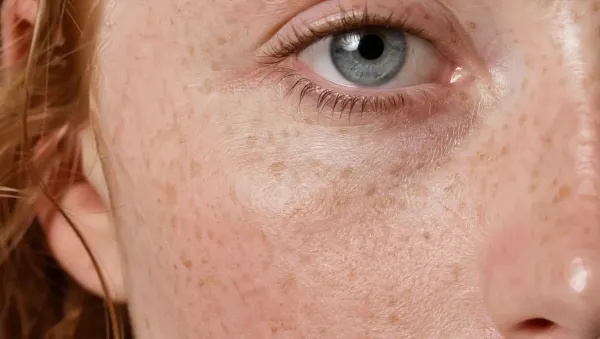
Rosacea affects an estimated 10 to 15 percent of Irish adults, according to Irish dermatologists. It is so prevalent among people of Celtic ancestry that it has long been treated as a feature of Irish skin rather than a condition requiring medical attention.
The flushing is put down to being outdoors. The redness is attributed to having a Celtic complexion. Many people live with it for years before seeking any kind of formal care.
When they do seek care, another barrier appears. Rosacea has historically been associated in Irish culture with alcohol consumption. The stigma around that association means some sufferers avoid going to the doctor at all, not wanting that assumption made, managing symptoms with makeup or over-the-counter products instead.
None of these cases are recorded.
Where you live changes everything
A study of melanoma diagnoses at University Hospital Kerry found that 45 percent of cases presented at an advanced stage, compared to the national average of 12.9 percent.
Kerry lacks a dedicated rapid-access pigmented lesion clinic.
The nearest specialist clinic is in Cork - over 100 kilometres away, often taking around two hours each way by car for many patients.
For elderly patients, for those without transport, for those who cannot take time off work, that journey does not happen.
Conditions progress. When they are finally diagnosed, they are already serious.
This is the rural penalty in numbers. It applies to inflammatory skin conditions just as it does to cancer.
People in rural Ireland are less likely to be formally diagnosed, less likely to be referred, and less likely to appear in any national data.
Skin cancer numbers are also wrong
Non-melanoma skin cancer is the most common cancer in Ireland, accounting for around a quarter to a third of all invasive cancers - approximately 26 to 27 percent in recent years.
But the number recorded significantly underestimates the true burden. The National Cancer Registry Ireland only registers the first occurrence of each type of non-melanoma skin cancer per person over their lifetime. Subsequent tumours, multiple simultaneous tumours and recurrences are not counted.
A landmark UK study analysing this exact registration rule found that it underreports basal cell carcinoma by approximately 53 percent and squamous cell carcinoma by 36 percent. Ireland's registry uses the same framework. The actual surgical and treatment workload is likely double the official figures.
The cost of not counting
When a melanoma is caught at Stage IA, the average treatment cost in Ireland is approximately €4,269. At Stage IV, it is €122,985 - more than 25 times higher, with dramatically worse outcomes for the patient.
The same principle applies across inflammatory skin conditions. Conditions that go undiagnosed, unmanaged and unreported for years become more severe, more complex and more expensive to treat.
What it adds up to
Ireland has a skin disease problem that is larger than any official number suggests. The barriers to diagnosis and recording are structural, educational, financial, cultural and geographic - and they compound each other.
The person who cannot afford a GP visit goes to the pharmacy.
The pharmacy manages it without a diagnosis.
The GP who does see a skin condition may not have the training to identify it precisely.
The referral that does happen enters a waiting list measured in years. The person in Kerry does not make it to Cork.
The rosacea sufferer manages it with makeup.
None of it is counted. And because it is not counted, it is not funded, staffed or taken seriously at a policy level.
The real number of Irish people living with skin conditions is considerably higher than what gets reported. Most of them already know that.
This article is for educational purposes only and is not a substitute for medical advice. If you have a skin condition, speak to your GP or dermatologist.